
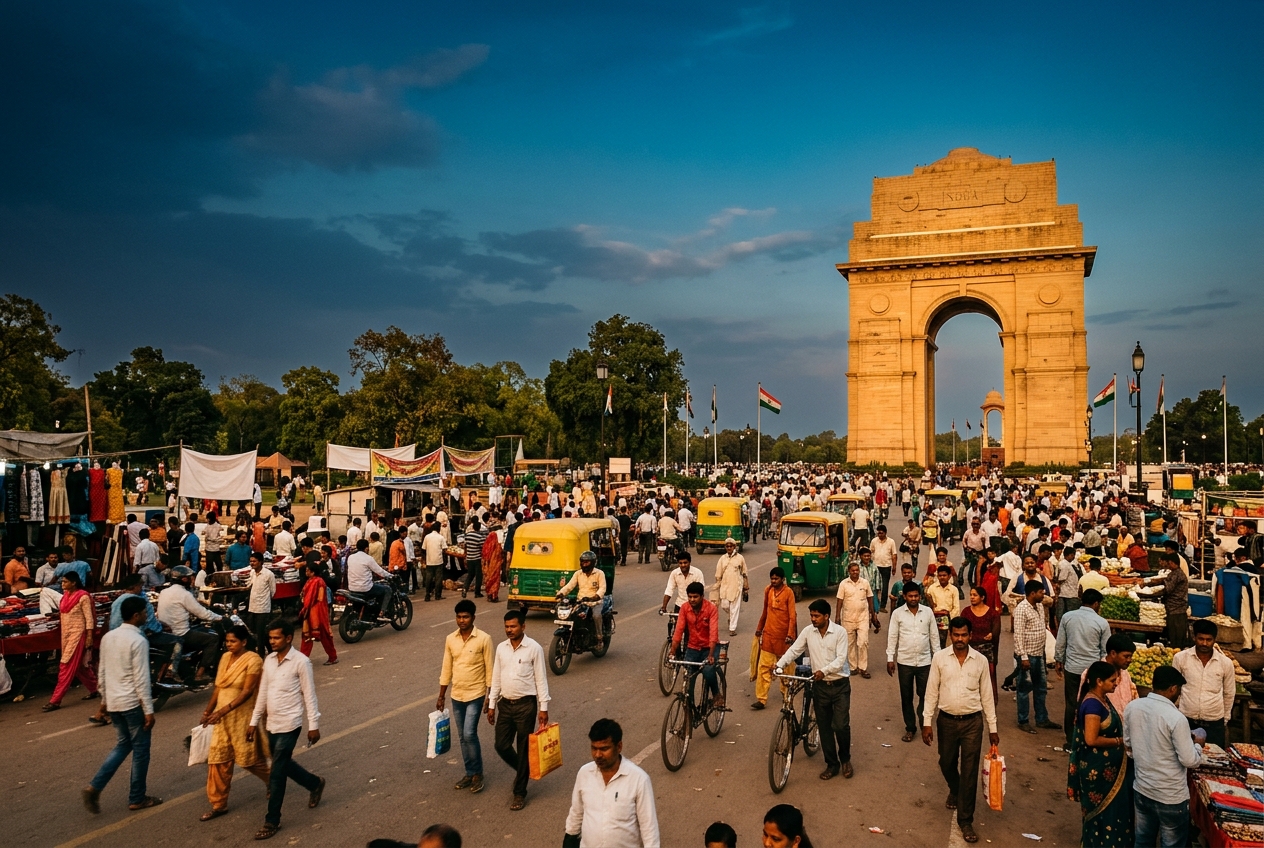
Cabinet Minister Piyush Goyal's article documents a decade of reform 810 million fed, 580 million financially included, 120 million families with free healthcare, 160 million households with tap water, 100 million women freed from smoke-filled kitchens through clean cooking fuel. These are extraordinary numbers. And every single one of them is an argument for social business.
Not because the government did not matter. It did enormously. The policy architecture, the political will, and the scale of public investment documented in this article represent exactly the kind of enabling environment that social business requires to thrive. But the World Chamber for Social Business reads this article and sees something the governance narrative does not fully name. Every gap that government policy identified and mobilised to close was a market that social enterprise could have been building in, sustaining, and scaling long before the state arrived. And in many cases, was. Here is what the article describes through a governance lens and what social business sees through an enterprise lens:
- #JanDhan bank accounts for 580 million people is financial inclusion at extraordinary scale. Social business sees 580 million people who are now bankable who can be reached by cooperative financial enterprises, by pay-as-you-go energy models, by agricultural input credit systems, by the community savings networks that were always the real financial infrastructure of India's informal economy.
- #AyushmanBharat healthcare coverage for 120 million families is the most ambitious public health commitment in India's history. Social business sees the community health enterprise opportunity that scales alongside it. The ASHA worker cooperative model. The affordable diagnostics social enterprise. The last-mile pharmaceutical distribution enterprise that reaches the families whose Ayushman card is their only health asset.
- #StartupIndia and #MakeinIndia creating a new generation of job creators from job seekers. Social business sees the 63 million micro, small, and medium enterprises that were always India's real employment engine most of them informal, most of them women-led, most of them operating without the institutional infrastructure that the formal startup economy takes for granted.
- #PM-KISAN transferring income support directly to crores of farmers. Social business sees the Babban Gona model applied to India cooperative agricultural enterprises that convert income transfers into invested capital, that double yields, that build the market connections that make farming a viable intergenerational livelihood rather than a poverty trap.
The social business reading of India's transformation is not a critique of governance. It is a completion of it. Because government can build the infrastructure. Government can set the policy. Government can create the enabling environment. But government cannot build the 10 million social enterprises that will sustain the outcomes of that infrastructure after the program cycle ends. Government cannot create the community ownership that makes Jan Dhan meaningful rather than dormant. Government cannot build the trust networks that make Ayushman Bharat reach the last mile.
That is what social business builds. And as India moves toward Viksit Bharat 2047 the vision of a developed India that Minister Goyal's article closes with the question the World Chamber for Social Business is asking is not whether India has the policy ambition. Demonstrably, it does. The question is whether the social enterprise ecosystem is being built at the scale and speed that matches it. Whether the cooperative frameworks are progressive enough. Whether the capital instruments exist for the missing middle. Whether the women building enterprises at the base of every supply chain in every village in India have access to the markets, the credit, and the legal infrastructure their ambition deserves. That is the Viksit Bharat 2047 agenda that social business must be part of.